
Doubly Linked List
"""
https://en.wikipedia.org/wiki/Doubly_linked_list
"""

from __future__ import annotations

from typing import Any


class Node:
    def __init__(self, data: Any) -> None:
        self.data = data
        self.previous: Node | None = None
        self.next: Node | None = None

    def __str__(self) -> str:
        return f"{self.data}"


class DoublyLinkedList:
    def __init__(self) -> None:
        self.head: Node | None = None
        self.tail: Node | None = None

    def __iter__(self):
        """
        >>> linked_list = DoublyLinkedList()
        >>> linked_list.insert_at_head('b')
        >>> linked_list.insert_at_head('a')
        >>> linked_list.insert_at_tail('c')
        >>> tuple(linked_list)
        ('a', 'b', 'c')
        """
        node = self.head
        while node:
            yield node.data
            node = node.next

    def __str__(self) -> str:
        """
        >>> linked_list = DoublyLinkedList()
        >>> linked_list.insert_at_tail('a')
        >>> linked_list.insert_at_tail('b')
        >>> linked_list.insert_at_tail('c')
        >>> str(linked_list)
        'a->b->c'
        """
        return "->".join([str(item) for item in self])

    def __len__(self) -> int:
        """
        >>> linked_list = DoublyLinkedList()
        >>> for i in range(0, 5):
        ...     linked_list.insert_at_nth(i, i + 1)
        >>> len(linked_list) == 5
        True
        """
        return sum(1 for _ in self)

    def insert_at_head(self, data) -> None:
        self.insert_at_nth(0, data)

    def insert_at_tail(self, data) -> None:
        self.insert_at_nth(len(self), data)

    def insert_at_nth(self, index: int, data) -> None:
        """
        >>> linked_list = DoublyLinkedList()
        >>> linked_list.insert_at_nth(-1, 666)
        Traceback (most recent call last):
            ....
        IndexError: list index out of range
        >>> linked_list.insert_at_nth(1, 666)
        Traceback (most recent call last):
            ....
        IndexError: list index out of range
        >>> linked_list.insert_at_nth(0, 2)
        >>> linked_list.insert_at_nth(0, 1)
        >>> linked_list.insert_at_nth(2, 4)
        >>> linked_list.insert_at_nth(2, 3)
        >>> str(linked_list)
        '1->2->3->4'
        >>> linked_list.insert_at_nth(5, 5)
        Traceback (most recent call last):
            ....
        IndexError: list index out of range
        """
        length = len(self)

        if not 0 <= index <= length:
            raise IndexError("list index out of range")
        new_node = Node(data)
        if self.head is None:
            self.head = self.tail = new_node
        elif index == 0:
            self.head.previous = new_node
            new_node.next = self.head
            self.head = new_node
        elif index == length:
            assert self.tail is not None
            self.tail.next = new_node
            assert self.tail is not None
            new_node.previous = self.tail
            self.tail = new_node
        else:
            temp = self.head
            assert temp is not None
            for _ in range(index):
                temp = temp.next
                assert temp is not None
            assert temp.previous is not None
            temp.previous.next = new_node
            new_node.previous = temp.previous
            new_node.next = temp
            temp.previous = new_node

    def delete_head(self):
        return self.delete_at_nth(0)

    def delete_tail(self):
        return self.delete_at_nth(len(self) - 1)

    def delete_at_nth(self, index: int):
        """
        >>> linked_list = DoublyLinkedList()
        >>> linked_list.delete_at_nth(0)
        Traceback (most recent call last):
            ....
        IndexError: list index out of range
        >>> for i in range(0, 5):
        ...     linked_list.insert_at_nth(i, i + 1)
        >>> linked_list.delete_at_nth(0) == 1
        True
        >>> linked_list.delete_at_nth(3) == 5
        True
        >>> linked_list.delete_at_nth(1) == 3
        True
        >>> str(linked_list)
        '2->4'
        >>> linked_list.delete_at_nth(2)
        Traceback (most recent call last):
            ....
        IndexError: list index out of range
        """
        length = len(self)

        if not 0 <= index <= length - 1:
            raise IndexError("list index out of range")
        delete_node = self.head  # default first node
        if length == 1:
            self.head = self.tail = None
        elif index == 0:
            assert self.head is not None
            self.head = self.head.next
            assert self.head is not None
            self.head.previous = None
        elif index == length - 1:
            assert self.tail is not None
            delete_node = self.tail
            self.tail = self.tail.previous
            assert self.tail is not None
            self.tail.next = None
        else:
            temp = self.head
            assert temp is not None
            for _ in range(index):
                temp = temp.next
                assert temp is not None
            delete_node = temp
            assert temp.next is not None
            assert temp.previous is not None
            temp.next.previous = temp.previous
            temp.previous.next = temp.next
        return delete_node.data

    def delete(self, data) -> str:
        current = self.head
        assert current is not None

        while current.data != data:  # Find the position to delete
            if current.next:
                current = current.next
            else:  # We have reached the end an no value matches
                raise ValueError("No data matching given value")

        if current == self.head:
            self.delete_head()

        elif current == self.tail:
            self.delete_tail()

        else:  # Before: 1 <--> 2(current) <--> 3
            assert current.previous is not None
            assert current.next is not None
            current.previous.next = current.next  # 1 --> 3
            current.next.previous = current.previous  # 1 <--> 3
        return data

    def is_empty(self) -> bool:
        """
        >>> linked_list = DoublyLinkedList()
        >>> linked_list.is_empty()
        True
        >>> linked_list.insert_at_tail(1)
        >>> linked_list.is_empty()
        False
        """
        return len(self) == 0


def test_doubly_linked_list() -> None:
    """
    >>> test_doubly_linked_list()
    """
    linked_list = DoublyLinkedList()
    assert linked_list.is_empty() is True
    assert str(linked_list) == ""

    try:
        linked_list.delete_head()
        raise AssertionError  # This should not happen.
    except IndexError:
        assert True  # This should happen.

    try:
        linked_list.delete_tail()
        raise AssertionError  # This should not happen.
    except IndexError:
        assert True  # This should happen.

    for i in range(10):
        assert len(linked_list) == i
        linked_list.insert_at_nth(i, i + 1)
    assert str(linked_list) == "->".join(str(i) for i in range(1, 11))

    linked_list.insert_at_head(0)
    linked_list.insert_at_tail(11)
    assert str(linked_list) == "->".join(str(i) for i in range(12))

    assert linked_list.delete_head() == 0
    assert linked_list.delete_at_nth(9) == 10
    assert linked_list.delete_tail() == 11
    assert len(linked_list) == 9
    assert str(linked_list) == "->".join(str(i) for i in range(1, 10))


if __name__ == "__main__":
    from doctest import testmod

    testmod()
About this Algorithm
Singly Linked List is a linear and connected data structure made of Nodes. Each node is composed of a variable data where its content is stored and a pointer to the next Node on the list. The Linked List has a pointer to the first element of this Node sequence and may also have another pointer to the last Node to make operations at the far end less time-consuming. You can also store a length variable to store the total length.
A Doubly Linked List (DLL) contains an extra pointer, typically called previous pointer, together with next pointer and data which are there in singly linked list.
Advantages over singly linked list
- A DLL can be traversed in both forward and backward direction.
- The delete operation in DLL is more efficient if pointer to the node to be deleted is given.
- We can quickly insert a new node before a given node.
In singly linked list, to delete a node, pointer to the previous node is needed. To get this previous node, sometimes the list is traversed. In DLL, we can get the previous node using previous pointer.
Disadvantages over singly linked list
- Every node of DLL Require extra space for an previous pointer. It is possible to implement DLL with single pointer though (See this and this).
- All operations require an extra pointer previous to be maintained. For example, in insertion, we need to modify previous pointers together with next pointers. For example in following functions for insertions at different positions, we need 1 or 2 extra steps to set previous pointer.
Time Complexity
| Operation | Average | Worst |
|---|---|---|
| Access | Θ(n) | O(n) |
| Search | Θ(n) | O(n) |
| Insertion | Θ(1) | O(1) |
| Deletion | Θ(1) | O(1) |
Example
class LinkedList {

    Node head;      // Pointer to the first element
	Node tail;      // Optional. Points to the last element

	int length;     // Optional

    class Node {
        int data;   // Node data. Can be int, string, float, templates, etc
        Node next;  // Pointer to the next node on the list
        Node prev;

        Node(int data) {
            this.data = data;
        }
    }


    // Adding a node at the front of the list
    public void push(int new_data) {

        /* 1. allocate node
         * 2. put in the data */
        Node new_Node = new Node(new_data);

        /* 3. Make next of new node as head and previous as NULL */
        new_Node.next = head;
        new_Node.prev = null;

        /* 4. change prev of head node to new node */
        if (head != null)
            head.prev = new_Node;

        /* 5. move the head to point to the new node */
        head = new_Node;
    }

    /* Given a node as prev_node, insert a new node after the given node */
    public void InsertAfter(Node prev_Node, int new_data) {

        /*1. check if the given prev_node is NULL */
        if (prev_Node == null) {
            System.out.println("The given previous node cannot be NULL ");
            return;
        }

        /* 2. allocate node
         * 3. put in the data */
        Node new_node = new Node(new_data);

        /* 4. Make next of new node as next of prev_node */
        new_node.next = prev_Node.next;

        /* 5. Make the next of prev_node as new_node */
        prev_Node.next = new_node;

        /* 6. Make prev_node as previous of new_node */
        new_node.prev = prev_Node;

        /* 7. Change previous of new_node's next node */
        if (new_node.next != null)
            new_node.next.prev = new_node;
    }
}
Adding node at front
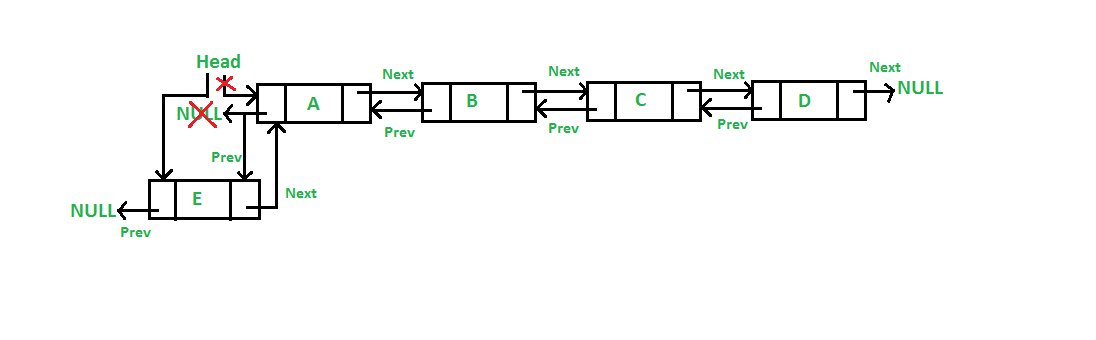
Add a node after a given node

Video Explanation
A CS50 video explaining the Doubly Linked List Data Structure